San Francisco Surgical Arts

What is Oral Surgery?

Oral Surgery is the branch of dentistry dealing with the diagnosis and treatment of disorder, disease, injury and defect of “maxillofacial” structure.  Maxillofacial can be defined by breaking the word into two parts, “maxillo” meaning maxilla or jaw bones and “facial” meaning the structure of the face.  A maxillofacial surgeon is an expert in the surgical treatment of the jaw, facial bones, teeth and surrounding soft-tissues.  Oral & maxillofacial surgeons care for a variety of conditions that include  problematic, lost or missing  teeth, TMJ/facial pain, malalignment of the jaws, cysts and tumors, cleft lip & palate, and facial fractures suffered by accidents

Extensive training is required to become an Oral Maxillofacial Surgeon.  It requires specialized training in pain control and anesthesia that allows maximum patient comfort.  As a part of any oral surgeons training they are required to be a anesthesia resident for a minimum of 4-6 months, in an accredited anesthesia residency.  This is where most oral surgeons learn the art of sedation and how to make patients comfortable during their surgical procedure.

An Oral Surgeon must typically complete four years of undergraduate study, with a heavy emphasis in the biological sciences, i.e. biology & chemistry.  Then after graduating with a BS (Bachelor of Science), most will go straight into four more years of dental school.  The first two years of the dental school mirrors most medical school curriculums, with some dental schools even having both their medical and dental students in the same classroom.  Of course with the dental students there is more emphasis on the head & neck area.  Then after the first two years, the “Clinical exercises” are preformed during the 3rd and 4th years of dental school.  This is where dental student start to work on actual patients.  This is in contrast to medical students, where very little clinical exercises are done in their rotations in the the 3rd & 4th years of medical school.  Upon completion of dental school curriculum, each dental student must pass the two national written exam and then one clinical exam (on live patients) to become a licensed DDS (Doctor of Dental Surgery) or DMD (Doctor of Dental Medicine).  Then each state or region has its own requirements and tests that are needed before they allow dentists to practice in their state.  This is typically another set of exams, after the national exams, that varies from state to state.

It is in the 4th of year of dental school that some students decide to further their training and specialize in a field of interest, i.e. a pediatric dentist (Pedodontist), oral surgery and so on.  In order to become a specialist in Oral Surgery an additional 4 to 6  year residency.   The difference between the 4 & 6 year program:  The 6 year program involves attending medical school as a full-time student and passing all the national boards and exams required of all medical doctors.  This includes all three USMLE exams and the required state exams.  So all in all by the time and oral surgeon is finished, they have taken over 10 national exams and boards!  Additionally the 6 year programs require all residents to do one year of PGYI in general surgery, where as an oral surgeon you are required to do anything from orthopaedic surgery to neurosurgery, to surgical oncology and general surgery.

Then for the super over-achievers, one can even further their oral surgery training and subspecialize in such things as surgical oncology, cosmetic surgery, implant dentistry by doing a fellowship or partaking in a variety of other masters programs such as MBA, PhD, MPH, MEd and so on.

Lastly, some oral surgeons elect to become “Board Certified”, where they are required to pass another written test, followed by an eight hour oral exam before their peers.  This is not a requirement but highly sought after by most oral surgeons.

So as you can see, to keep a valid license an Oral Surgeon must endure strict and rigorous continuing education requirements.  Most oral surgeons that have attended both dental and medical school, have to maintain active licenses in both fields and a minimum number of hours educating themselves throughout their lives, via “Continuing Education”, i.e. “CE” courses.  For instance in the state of California, each medical doctor is required by the Medical Board to attend a minimum of 25 hours of CE’s each year.  This is in addition to the California Dental Board (CDA) requirement of 25 hours.  So all in all each surgeon spends 50 hours each year to improve their skills and to keep up with the ever-increasing body of knowledge.

All of the doctors at SFSA are Board Certified Oral & Maxillofacial Surgeons and some with even have further fellowship-training in facial cosmetic surgery.  Please click here for details on the education and training of the doctors of San Francisco Surgical Arts.

Our Founding Father’s Contribution to the Foundation of Dentistry

Contrary to popular belief George Washington did not have wooden teeth.  The enzymes found in saliva break down wood too quickly to make wood ideal for dentures.

According to history, George Washington began loosing teeth at the age of 18.  Historians argue that the stress of being a general in the army compiled with poor genetics, contributed to Washington’s many oral hygiene problems, including frequent abscess and infection in the mouth.  It was routine procedure for Washington to have his teeth extracted.

Washington’s dentures, composed of ivory, gold and animal teeth (such as hippopotamus or human), were made by Dr John Greenwood, a respected dentist of the time.  Two gold plates lined the upper and lower arches of the mouth, fixed together by springs, which were believed to mal-function frequently.  It is said that Washington had to apply force to keep his mouth closed, and when relaxed his mouth would spring open.  There are even stories about the president having to cancel speeches because his mouth was stuck open.

One set of George Washington’s dentures was given to the Maryland Dental School, where it remains to this day.

A second was given to the Smithsonian, but stolen, presumably for its gold content.

Click here  to see a picture of George Washington’s actual teeth.


BELIEVE IT OR NOT…

Believe it or not the earliest dental implants were discovered in Honduras at the excavation of a Mayan burial site in 1931.  The remains dated back to 600 AD.

Archeologists discovered a fragment of a mandible, believed to belong to a female in her early 20s.  She had three tooth shaped pieces of shell placed into the sockets of missing teeth.  Deciding whether the shells were placed into the mandible during her life or post-mortem was a highly debated topic.

However, in 1970 a Brazilian dental academic, Professor Amadeo Bobbio studied the mandibular specimen and took a series of radiographs. He noted compact bone formation around two of the implants which led him to conclude that the implants were placed during life.[1]

Dr Lenard Linkow is considered to be the father of modern implant dentistry.  He began placing implants in 1952; by the time he retired in 2002 he placed over 19,000 dental implants and published 12 books on the subject.


[1] Wikipedia; http://en.wikipedia.org/wiki/Dental_implant#cite_note-32

WHY DENTAL IMPLANT

A dental implant is an elective option for tooth replacement.  It is usually recommended when a patient is in good oral and physical health.  Even though the same implant material has been used in the human body since the 1950’s, it is just now that it is becoming the preferred way or even the “standard of care” for replacing teeth.  Out of all the different treatment options for a missing tooth, dental implant have one of the greatest longevity.

The density of the bone, location of maxillary sinuses and other vital structures such as nerves & arteries are just some of the factors that come into play when deciding if a dental implant is right for you.   A trained and skilled oral surgeon can help you review all of the potential pros and cons of getting a dental implant.  In some cases, additional work, such as bone-grafting may be required in order to have enough healthy bone to obtain an implant.

For those patients that are not good candidates for implant, other options such as a “bridge” exists.  A bridge is a type of “fixed” dental restoration, meaning it is fixed to the adjacent teeth and is not removed on a daily basis.  Most commonly a bridge contains three units, anchored by one tooth on each side of the gap and a “pontic” or fake tooth that takes the place of the missing tooth.  

Some handicaps of a bridge may be, shaving, or prepping the adjacent teeth which may have nothing wrong with them.  This may affect the over-all health and longevity of the site surrounding the missing tooth.  Also, the bone below the missing tooth will resorb after time without proper stimulation to help maintain its density.  Since a dental implant is place inside the bone, it helps to stimulate and maintain the bone.


A third option is removable denture or partial.  A partial is a less expensive option than an implant or a bridge.  A partial is a removable acrylic structure that snaps into place with metal clasps.  Removable partials have a similar function to natural teeth and are a good option for some patients.

WHAT IS A DENTAL IMPLANT?

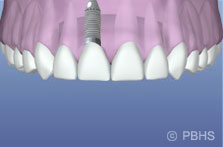
A dental implant is a devise that is implanted into the jawbone as a means of restorating a missing or failed tooth.  Most dental implants are made of moslty titanium and are similar in size and shape to the natural root of the tooth.  Dental implants can have a screw-like feature with enhanced coating to help expedite its “osseointegration”.  Osseointegration is the process in which the bone integrates and fuses with an object, in this case: the implant

Afterwards the dental implant acts as an anchor or support-structure for a dental prostheses, such as a crown.  Typically a dental implant will look and feel like a natural tooth in both aesthetic and function.  It is important that the patient continues brushing and flossing the implant as if it were a natural tooth.

“Dental implant success is related to operator skill, quality and quantity of the bone available at the site, and the patient’s oral hygiene. The consensus is that implants carry a success rate of around 95%”[1]


[1] Esposito M, Grusovin MG, Willings M, Coulthard P, Worthington HV (2007). “The effectiveness of immediate, early, and conventional loading of dental implants: a Cochrane systematic review of randomized controlled clinical trials”. The International Journal of Oral & Maxillofacial Implants 22 (6): 893–904. PMID 18271370.

Congratulations Doctors Hoghooghi, Massoomi, Sodeifi and Surpure for becoming BIOMET 3i Implant Providers!!!


Dental implant therapy is among the most advanced technologies for tooth replacement.  Substituting the roots with a BIOMET 3i Implant generates a natural biological process allowing the implant to bond with the bone, resulting in the look and feel of a natural tooth.

SFSA is one of the first practices in Silicon Valley to integrate the use of the digital impressions (iTero) with 3i’s Encode Abutment system.

BIOMET 3i offers one of the most advanced and comprehensive lines of dental implants>  This line of implants is supported by a growing line of site preparation and regenerative products (Bone grafting). BIOMET 3i pioneered the development of biologically driven dental implants, winning worldwide acclaim for the microtextured surface and superior clinical success rates of the OSSEOTITE® Dental Implants.*

San Francisco Dental Professionals:

Dr. Alexander  Hoghooghi   D.D.S  M.D 
Business Name:  San Francisco Surgical Arts
Specialty:  Oral Surgery
301 Main Street Unit 1-A
.
SAN FRANCISCO, CA  94105
Phone:  415-813-6400  Fax:  415-813-6401
Email:  [email protected]
Office Hours:  Mon-Fri 9am-5pm
Miles From You:  0
Dr. Nima S.  Massoomi  D.M.D  M.Ed  M.D
Business Name:  San Francisco Surgical Arts
Specialty:  Oral Surgery
301 Main Street Unit 1-A
.
SAN FRANCISCO, CA  94105
Phone:  4158136400  Fax:  4158136401
Email:  info@sfsurgicalarts.com
Office Hours:  Mon-Fri 9am-5pm
Miles From You:  0
Dr. A, Michael  Sodeifi  D.M.D  M.D  M.P.H
Business Name:  San Francisco Surgical Arts
Specialty:  Oral Surgery
301 Main Street Unit 1-A
.
SAN FRANCISCO, CA  94105
Phone:  4158136400  Fax:  4158136401
Email:  [email protected]
Office Hours:  Mon-Fri 9am-5pm
Miles From You:  0
Dr. Sudheer  Surpure  D.D.S  M.D  
Business Name:  San Francisco Surgical Arts
Specialty:  Oral Surgery
301 Main Street Unit 1-A
.
SAN FRANCISCO, CA  94105
Phone:  4158136400  Fax:  4158136401
Email:  [email protected]
Office Hours:  Mon-Fri 9am-5pm
Miles From You:  0


** http://biomet3i.com/?pageid=346667760014&Reg=North%20America&CTY=UNITED%20STATES&Lang=EN

IMAGINE – – No More Gagging!!


San Francisco Surgical Arts Now Introducing: iTero 3D Digital Impression System.

Cadent iTero uses state of the art technology to capture digital images of your teeth.

Imagine – no more gagging, no more uncomfortable tray and messy putty.

Imagine spending less time at the dentist office and more time enjoying your smile!

Through the use of laser and optical scanning, Cadent iTero 3D Impression System captures the surface area and contours of the tooth and gingival structure.

This unique product results in a precision crown that requires minimal adjustment, thus saving you time and money by reducing the amount of trips to your dentist’s office.

This superior technology also allows your doctor to communicate with the laboratory more effectively by electronically sending the file.  So now your doctor and the lab technician can view and discuss the case in conjunction.

As a patient, your experience is enhanced in many ways.  No more gagging on messy and uncomfortable impression trays and materials.  Less time spent traveling back and forth to your dentist’s office.  And, your dentist will be able to show you digital images of your teeth to explain the process of your personal procedure more effectively.

Also because there is less waste of resources, including those plastic impression trays, iTero is environmentally conscious!

ITERO IS A SAFE AND EFFECTIVE TECHNOLOGY THAT WIL ENHANCE YOUR DENTAL EXPERIENCE.  Here at SFSA, we are proud to be among the first to offer you this level of comfort and expert service.

***For more information please contact our friendly staff at San Francisco Surgical Arts.